
Why Is Education Important in Life?
Education is the best ladder to personal development, professional accomplishment and a thriving life. It does more than get students ready for tests or degrees; it influences thinking, behavior, confidence and the capacity to confront life’s challenges wisely. At Global NextGen Academia, we recognize that expert online teachers can not only teach quality education and curriculum, but can also transform students academically, psychologically, and socially. In order to appreciate why education is good for you in life, let’s first discuss its benefits and then analyze the two main types of education—formal and informal, and how both contribute towards your success.
1. Education Develops Thinking and Decision-Making Skills
One of the greatest advantages of education is that it enables you to think rationally and take the right decisions. Education trains students to think, to digest questions, rather than to rush to answers.
Example:
When students study mathematics, physics or chemistry, how to find a solution step by step is taught. These analytical skills come into play in work or real life when you’re managing your money, preparing a business plan or trying to address your daily problems in a calm and rational way. Informed people make better decisions because they use logic, not speculation.
2. Education Builds Confidence and Self-Expression
Knowledge is enlightening, and enlightenment gives you confidence. One of the benefits of education is that it allows people to think and speak well about themselves in various contexts.
Example:
An educated individual can participate with confidence in class discussions, interviews, meetings, or any public speaking events. They know how best to present their case, are excellent listeners, and can respond noteworthy. This confidence plays a crucial role in leadership, teamwork, and professional success.
3. Education Creates Career Opportunities and Stability
An education grants people access to a variety of job opportunities, and it gives them the ability to make a living for themselves. As a basic necessity today, many jobs require more education with more education, more opportunity for great jobs and worth.
In a similar fashion, a person having completed their secondary or higher education can sit for office jobs, can go for professional courses, or can go for higher studies. On the other hand, the uneducated person is limited in options, and often just looking for a job. A better education means it’s easier to get a better job, but it can also mean getting up earlier in the morning, not for sleeping in.
4. Education Teaches Discipline and Responsibility
Education instills discipline, punctuality, responsibility – all very critical components for success in personal and professional lives.
Example:
Students who are accustomed to juggling homework, assignments, exams and deadline have a sense of time management and are less likely to slack off. These practices will serve them well later when they are working or running a business, as they, too, will need to attend to a schedule, hire themselves out to a schedule, and so on.
5. Education Helps in Everyday Life
Education is not just about writing and arithmetic, it increases your capacity to live – be better informed about the things around you and you can make safer and healthier choices.
Example:
A basic science education enables a person to know how to use electrical power, to be safe with gas, sanitation, health and nutrition. This information can contribute to a better way of life, healthier environment, and more informed of what’s around.
Types of Education
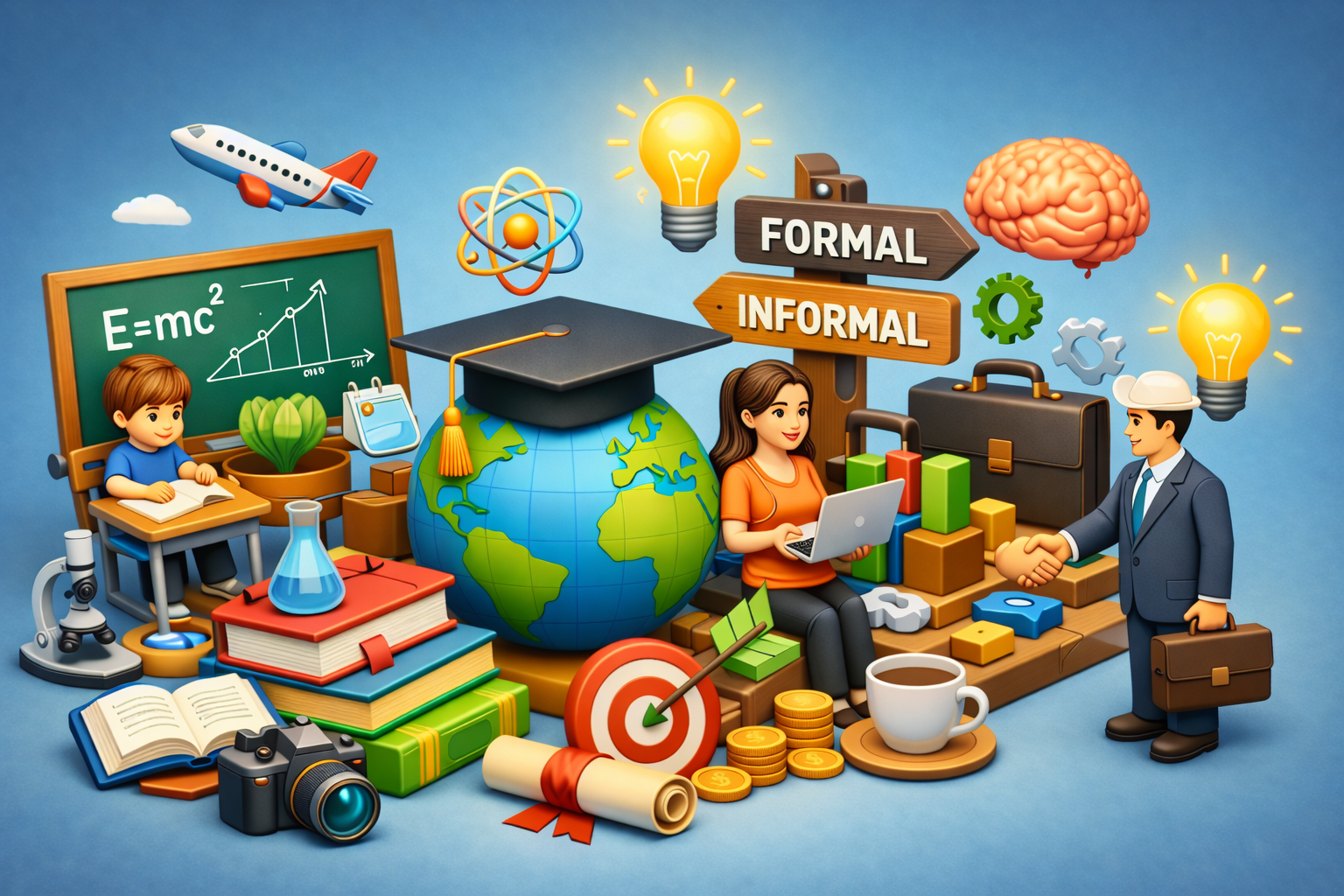
Education may be subdivided in a general way two kinds: formal and informal education. Each of these forms of education is important for the development of a person’s character, skills, and life.
Formal Education
Formal education is organized instruction or training that usually takes place within the walls of a school, in a classroom and on a predetermined schedule. It embraces a systematic syllabus, including text-books, examinations and certificates.
Importance of Formal Education:
- Best teacher to knows how to teach — He / She can manage basic and higher level academic knowledge.
- Recognized in various degrees and certification.
- Because of it, you will get a job or will be able to enter higher education.
- Enhances skills in writing, research and communicating with other students.
Example:
Doctors, engineers, scientists and teachers need to be formally educated. It’s impossible to go into these professions without the right degrees and certifications. Formal education imparts the requirements of professional acceptance and credibility.
Informal Education
Informal education is education without formal schooling(World Bank, 1990: 5). It is the process of learning that takes place outside of the formal classroom setting, and includes learning from experience, from the people, surroundings and real life events.
Importance of Informal education:
- Learns life skills and practical skills
- Encourages innovation, creativity and self-reliance.
- Assist with learning academic stuff in proper situation
Example:
Such as: Someone in business may know management theories from school, but customer handling, negotiating, leading and taking decisions are things he graduates from everyday life. Wisdom and street smarts are honed by informal education.
Conclusion
Both forms of education are necessary because they work together in building a successful human being. Formal education is the core- the disciplined knowledge, structured academic learning, recognized certification and distinct career prospectus. It teaches you what to know, and also gives social and professional recognition.
Informal education, by contrast, instructs what to do with that knowledge in the world of life. It imparts practical knowledge, flexibility, assurance and know-how which can’t be attained merely by books.
A man may have no opportunities and no rcognition under the sun.
Without informal learning, you might know some things but not know how to make the best use of them. Together these two types of education give new birth to balance, wisdom, and success in the long run.
At Global NextGen Academia, our mission is to blend strong formal education with practical understanding through expert online teachers and high-quality teaching methods. By connecting classroom learning with real-world application, we aim to prepare students not only for exams and careers but also for life’s challenges, responsible decision-making, and a successful future.