

Introduction to physics(from beginning till now)
What is physics?
Physics is a science that investigates matter, energy, motion, and the forces that govern the universe. It accounts for the way everything in the world operates, starting from the tiniest particles that make up atoms to the enormous entities in space. The focus of physics is on the natural laws that regulate movement, energy transfers, vibrations, waves, temperature, contact, magnetism, and the makeup of matter. Furthermore, it does this by offering both mathematical and experimental interpretations of the phenomena in nature, which in turn enables scientists to comprehend how and why the universe behaves in a certain way. Simply put, physics is the basis of all other physical sciences and the essential tool for comprehending the natural world, and this is the same scientific approach followed at Global Next Gen Academia.

Why physics is important in everyday life
To begin with, Physics is behind the electric power that is used at home and at work, and can also be found in such devices as mobile phones, computers, and internet technology, in which electricity is utilized.
Moreover, the matter of physics can be observed in the manner that operations of cars, airplanes, and transportation systems are executed.
In addition, the application of physics in medicine includes instruments such as X-ray, MRI, and ECG.
Furthermore, it also makes GPS navigation and satellite communication possible.
Similarly, Physics is also a part of sound, music, and microphone technologies, as well as light bulbs, lasers, and solar energy.
Besides all that, air conditioners, heaters, and other cooling systems are examples of physics in daily life.
As a result, every action—from walking to driving, switching on a fan, or charging a phone—works as per the laws of physics.
Ultimately, Present-day life, technology, engineering, and communication would not be there if physics were absent.
Consequently, it is still intimately linked with accomplishing health, transportation, security, comfort, and innovation goals.
Modern research in physics
Modern physics is focused on revealing the most profound secrets of the universe and on the application of those insights in advanced technologies. Among the important fields are:
- Quantum computing: Building computers that use quantum particles to process at incredibly fast speeds
- Dark matter & dark energy: Studying the unseen elements that make up most of the universe
- Particle physics: Studying Quarks, Leptons, and the fundamental forces with particle accelerators
- Fusion energy: Harnessing the power of the Sun for a limitless source of clean energy
- Nanotechnology: Synthesizing novel types of materials on the scale of atoms and molecules
- Black hole research: Understanding gravity, space-time, and how our universe was born
- Cosmology: The study of the universe’s past, present, and future
- Superconductors: Zero-resistance materials, usable for energy and transportation
The directions of work in these fields hold great promise for the future in science, medicine, energy, communication, and space travel.
How physics came into existence
Physics began with the first man who looked out from his cave and noticed what happened in the world around him. There are some questions that have always perplexed mankind:
- Why do things fall?
- Why do we have sunrises and sunsets?
- Why does the Sun come up and go down?
- Why do we have seasons? How do stars move?
Among other things, the ancient Babylonian, Egyptian, Indian, and Greek observers and recorders of planetary motions also applied mathematics to the study of nature. Greek philosophers like Thales, Pythagoras, and Aristotle sought rational explanations for the world around them, rather than relying on myth for answers as they did.
Then, in the context of the Scientific Revolution, physics was established as a systematic science based on the work of Copernicus, Kepler, Galileo, and Newton. Based on their observations, experiments, and mathematical laws, physics was given not only a solid foundation but also transformed into a formal scientific discipline that continues to grow to this day.
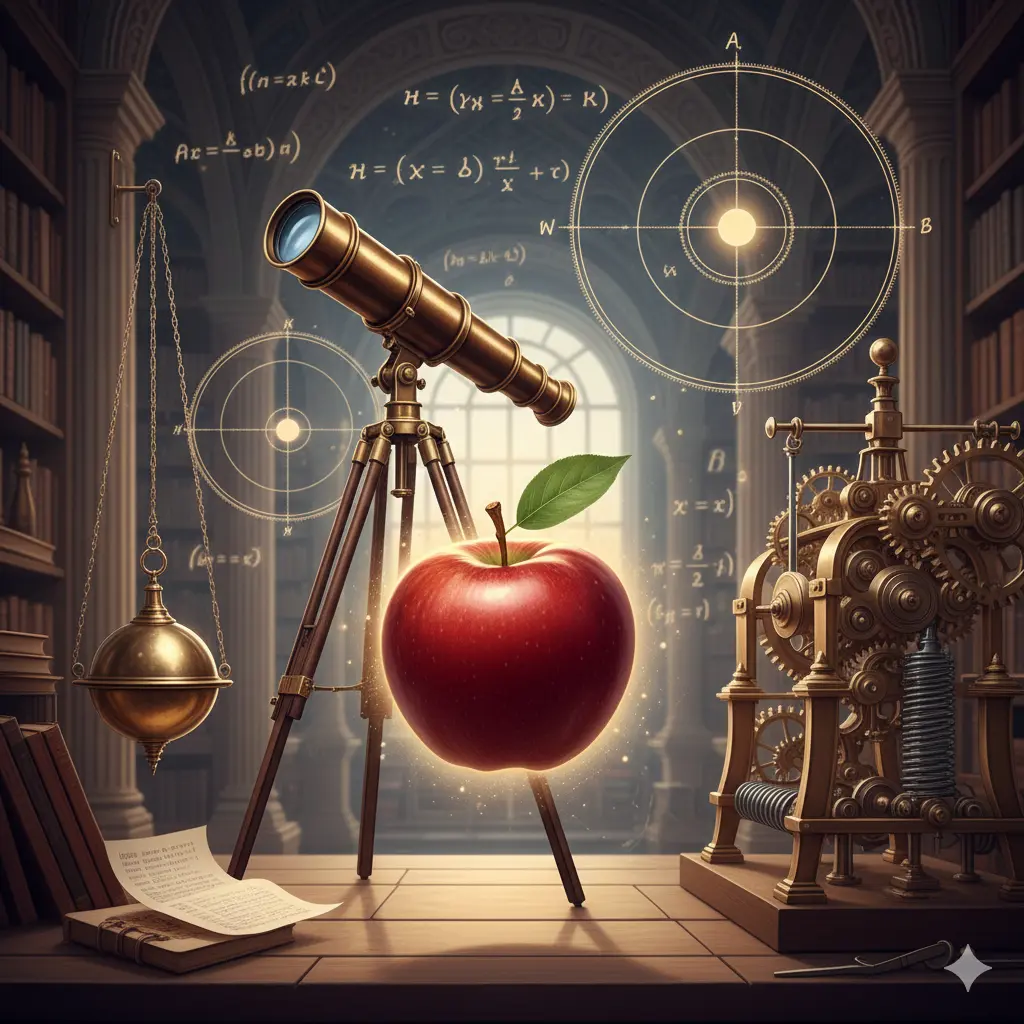
Important eras of physics with the biggest scientist and their biggest discoveries
Ancient Era:
Aristotle: First concepts regarding movement, elements, and natural laws
Classical Era:
Archimedes: The laws of density, leverage, and buoyancy force
The Scientific Revolution:
Copernicus: Model of the solar system – heliocentric
Kepler: The planets move according to the laws of motion!
Galileo: Motion to be proven by experiments, telescope discoveries
Newton: Laws of motion, gravity, classical mechanical laws
19th Century:
Faraday: Electromagnetic induction
Maxwell: Electromagnetic wave equation
Joule: Energy conservation
Early 20th Century:
Einstein: Relativity (space, time, gravity)
Planck: Quantum theory
Bohr: Atomic model
Heisenberg and Schrödinger: The basis of quantum mechanics
Late 20th Century & Modern Era:
Feynman: Quantum electrodynamics
Higgs: Higgs boson particle
Stephen Hawking: Black hole radiation theory
The transition from these times and the breakthroughs have transformed the field of physics into the contemporary science it is now.
All the Biggest Branches of Physics
Some major branches of physics include:
- Classical mechanics
- Electromagnetism
- Thermodynamics
- Optics
- Quantum mechanics
- Relativity
- Nuclear physics
- Particle physics
- Plasma physics
- Astrophysics
- Geophysics
- Acoustics
- Condensed matter physics
- Computational physics
Each branch deals with different forms of matter, energy, motion, and natural laws.
Relationship of physics with other subjects
Although physics is the most fundamental of sciences, it is relevant to and can be applied in a whole range of other disciplines:
Mathematics: Physics uses it to write equations and do calculations.
Chemistry: Atomic structure, bonding, energy levels.
Biology: Biomechanics, Signals in nerves, Machines for imaging.
Computer Science: Simulations, algorithms, quantum computing.
Engineering: Construction, electronics, machines, vehicles.
Astronomy: Space planets, stars, black holes.
Environmental science: Climate, energy systems, radiation.
This synergy is what keeps physics the engine of scientific inquiry and technological advancement.
Future of physics
The future of physics is full of exciting possibilities:
- Unlimited fusion energy
- Advancement in quantum computers
- Discovery of dark matter particles
- Space travel and human settlement beyond Earth
- Ultra-fast communication systems
- AI-powered physics simulations
- New materials with extraordinary properties
- Deep understanding of black holes and the early universe
Future physics will shape global technology, medicine, environment, and space exploration.

summery
Physics describes how the universe operates, from minuscule particles to massive galaxies. It is necessary for technology, engineering, medicine, and even cooking. From Pythagoras to Newton, brilliant men left us with insights that have shaped the building blocks of modern physical thinking. Today, physics is still evolving with cutting-edge research in quantum computing, particle physics, cosmology, fusion energy, and much more. Its future is a wake filled with revolutionary technologies and profound understandings of the universe.
To support this evolving journey of learning, Global Next Gen Academia provides an online platform where teachers guide students toward mastering physics with confidence.